Spices · Profile
Celery Seeds: Flavor, Chemistry, Uses and What the Research Shows
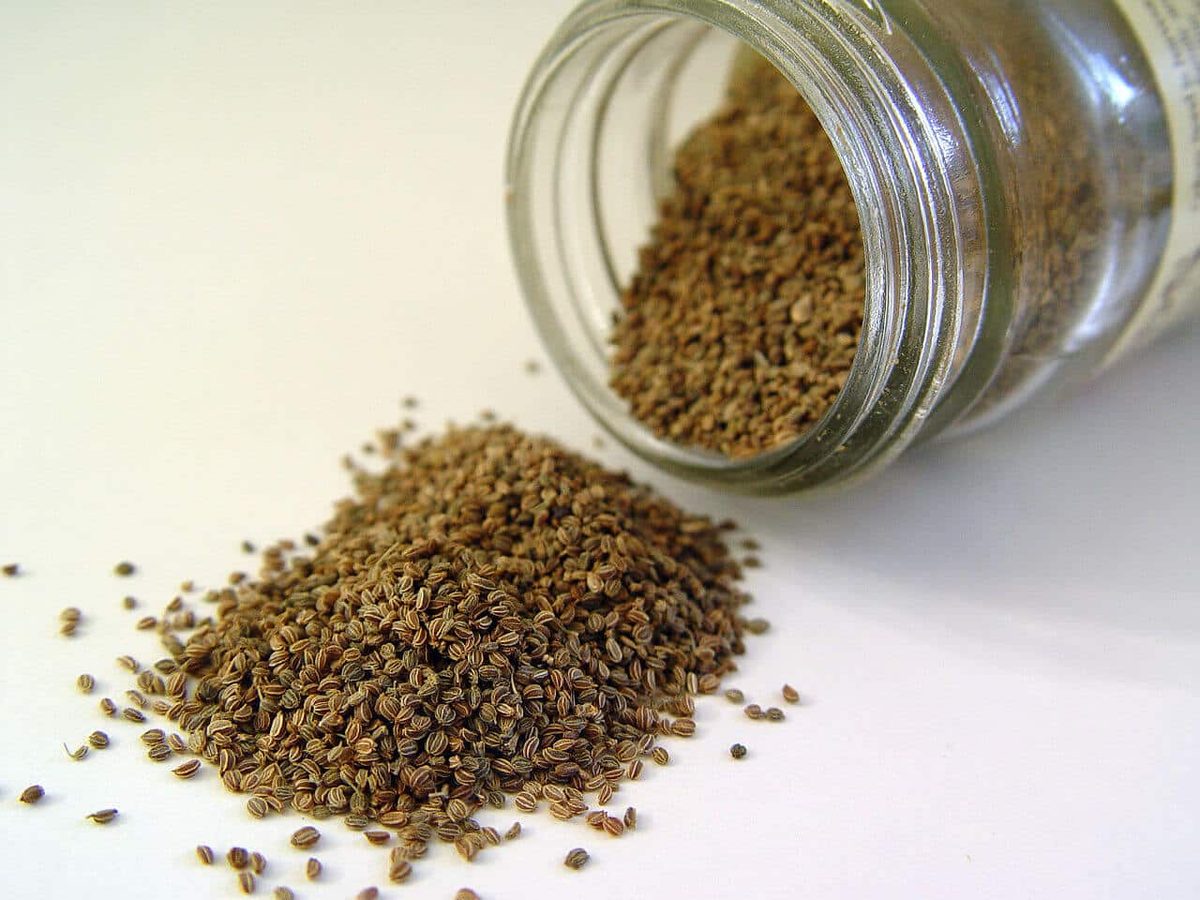
Celery seeds are the tiny dried fruits of the celery plant, Apium graveolens. They taste of celery, only far more concentrated and with a bitter edge, and a pinch goes a long way in pickles, dressings, slaws and spice rubs. This page covers what the seed is (and is not), the chemistry behind the smell, how it is used, its nutrient content per teaspoon, and the regulatory points worth knowing: a celery allergen rule in Europe and a new international lead limit.
At a glance
| Botanical name | Apium graveolens L.1 |
| Plant family | Apiaceae (carrot/parsley family)1 |
| Part used | The dried fruit, sold as “seed”2 |
| Native range | Macaronesia to North Africa, and Europe to the western Himalaya1 |
| Essential oil | About 3% of the seed’s dry weight3 |
| Key aroma compounds | Phthalides (character); limonene (most abundant)23 |
| Production | India: 7,598 tonnes in 2024-25; no world total found4 |
| Forms sold | Whole seed, ground seed, celery salt (salt plus ground seed)5 |
| Lead limit | Codex 2024: 1.5 mg/kg for dried celery seed67 |
Measured values
9 figures, sourced| Measure | Value | Scope | Source |
|---|---|---|---|
| Essential oil | about 3 % of seed dry weight | 2019 review (Salehi et al.) | mdpi.com |
| Limonene | about 60 % of oil | celery oil in general, not seed oil alone (Salehi et al. review, 2019)Sources differ | mdpi.com |
| Limonene | 70–80 % of oil | celery oil in general (Katzer)Sources differ | gernot-katzers-spice-pages.com |
| Phthalides | 20–30 % of oil | celery oil in general (Salehi et al. review, 2019) | mdpi.com |
| β-Selinene | up to 13 % of oil | celery oil in general (Salehi et al. review, 2019) | mdpi.com |
| Calcium Nutrient | 1,770 mg per 100 g | celery seed, USDA FoodData Central FDC 170920 | fdc.nal.usda.gov |
| Iron Nutrient | 44.9 mg per 100 g | celery seed, USDA FoodData Central FDC 170920 | fdc.nal.usda.gov |
| Manganese Nutrient | 7.57 mg per 100 g | celery seed, USDA FoodData Central FDC 170920 | fdc.nal.usda.gov |
| Lead, maximum Limit | 1.5 mg/kg | Codex 2024, dried celery seed, as reported in a law-firm summary (not the Codex text) | natlawreview.com |
Each figure is quoted as its source states it, with the samples or standard it applies to. Where sources differ, both are shown; nothing is averaged. All measured values
What celery seed is
Celery seed comes from celery itself. Katzer describes the plant’s fruits, often called celery seeds, as a strong though uncommon spice, and a 2019 review of the genus refers simply to “the seed of celery.”23 Kew lists Apium graveolens as a biennial of temperate regions.1
A widely repeated claim says celery seed comes not from celery but from lovage or another “wild” plant. Lovage is a different plant altogether: Levisticum officinale, the only member of its genus, with a native range Kew gives as southern Iran to Afghanistan.89 We found no source showing that commercial celery seed is lovage seed. For that herb, see lovage.
Flavor and the compounds behind it
The seeds have a similar but much stronger aroma than the celery leaf and root, according to Katzer, who also calls them slightly bitter and notes that some people compare them to fenugreek.2 Modern celery cultivars, he adds, are much lower in bitter compounds than wild forms or the celery of Roman times.2 To our taste, the seed reads as concentrated celery with a grassy, faintly citrus edge and a bitter finish.
The aroma sits in an essential oil that makes up about 3% of the seed’s dry weight.3 Two sources give different figures for its make-up, and both describe celery oil in general rather than seed oil alone:
| Compound group | Salehi et al. review (2019) | Katzer |
|---|---|---|
| Limonene | About 60% | 70–80% |
| Phthalides | 20–30% | Named, with sedanenolide “only in traces” |
| β-selinene | Up to 13% | Named among the sesquiterpenes, with humulene |
The review states that a series of phthalides gives celery oil its characteristic smell, naming sedanenolide and 3-n-butylphthalide as present in remarkable quantity.3 Katzer also credits phthalides, including 3-butylphthalide and sedanenolide, with the fragrance, but says the latter occurs only in traces.2 Limonene is the most abundant compound but not the one that makes celery smell like celery.
Origin and history
Kew gives the native range of Apium graveolens as Macaronesia to North Africa and Europe to the western Himalaya.1 Katzer writes that celery fruits and leaves were common flavorings in the Roman Empire, more common in the Apicius cookbook than today, and that the seeds are now rarely used.2 So the idea that celery seed only became a cooking spice in the 19th century does not hold up.
Several other history claims circulate: that celery appears in texts from before 850 BCE, that the Roman writer Celsus prescribed the seed for pain, and that ancient Chinese, Japanese and Ayurvedic healers used it. We could not open a source for any of them, so they are left out.
Production
India’s Spices Board reports celery at 7,598 tonnes from 4,964 hectares in 2024-25 (final), with the same figure carried as the 2025-26 advance estimate; the three years before ranged from 6,557 to 6,882 tonnes.4 The Board notes that figures from 2020-21 on are subject to revision.4 Claims that most celery seed comes from China, or that France is a major producer, could not be checked against any statistical source.
How celery seed is used
- Pickles, slaws and dressings. These are the classic North American uses, a matter of common practice rather than a sourced fact.
- Celery salt. McCormick’s celery salt lists just two ingredients, salt and celery seed.5 See celery salt and celery seed vs. celery salt.
- Seasoning blends. McCormick’s Cajun seasoning lists celery seed among its spices.10 See Cajun seasoning.
- Cooked vegetables. Katzer calls the seed a great addition to cooked vegetables and a rewarding spice to experiment with because it stands up to heat.2
- South Asia. Katzer says celery seed works as a substitute for radhuni in the Bengali mix panch phoron, and that it is sometimes listed in curry powder, probably for the same reason.2 See panch phoran and curry powder.
For more ideas, see celery seed uses.
Nutrition per teaspoon
USDA’s entry for celery seed gives a teaspoon as 2 g.11 Per teaspoon, computed from USDA’s per-100 g values and the FDA’s Daily Values:1112
| Nutrient | Per 100 g (USDA) | Per teaspoon (2 g) | % Daily Value (FDA) |
|---|---|---|---|
| Calcium | 1,770 mg | 35 mg | about 3% of 1,300 mg |
| Iron | 44.9 mg | 0.9 mg | about 5% of 18 mg |
| Manganese | 7.57 mg | 0.15 mg | about 7% of 2.3 mg |
Per 100 g the numbers look large, but a teaspoon contributes only a few percent of daily needs.
Buying and quality
No grading standard for celery seed was opened for this page. Whole seed should be uniform and free of chaff, with a strong celery smell when crushed; that is kitchen judgment.
Storage
No published shelf-life figure for celery seed from a regulator or standards body was found. Keep whole seed sealed, cool and dark, grind it as needed, and judge it by smell. That is common practice, not a tested figure.
Safety
- Allergen labeling. In the EU, celery and products made from it are among the allergens that must be emphasized in the ingredient list.13 Celery is not one of the nine major food allergens under US law.14
- Lead. In 2024 the Codex Alimentarius Commission adopted new maximum lead levels for spices, including dried celery seeds.7 According to a law-firm summary of the committee’s outcome, the general limit for dried seeds (0.9 mg/kg) does not apply to celery seed, which has its own limit of 1.5 mg/kg.6 The figures here come from that summary, not the Codex text itself.
Health claims
Celery seed is promoted for arthritis, gout, muscle spasms, anxiety and high blood pressure, and as a mosquito repellent. Here is what we could find:
- Blood pressure, blood sugar and lipids. A 2025 systematic review and meta-analysis pooled 10 randomized controlled trials with 511 adults. It found reductions in systolic and diastolic blood pressure, fasting blood sugar and triglycerides, but no effect on total, LDL or HDL cholesterol.15 The trials tested celery in several forms, not only the seed; a subgroup suggested celery seed or preparations above 1,000 mg a day worked better than other parts of the plant.15 The authors flag substantial heterogeneity and small samples and call for larger, longer trials, and they report no significant difference in adverse events between celery and placebo.15 This page reports the review from its abstract only.
- Everything else. We found no systematic review or regulator summary supporting the claims for arthritis, gout, muscle spasms, anxiety or insect repellence, and they are not repeated here.
This page makes no claim that celery seed treats or prevents any condition.
Substitutes and comparisons
Celery salt carries the same flavor but adds a lot of sodium; dried celery leaves or flakes give a milder celery note. No source gives a tested swap ratio. See celery seed substitutes, celery seed vs. celery powder, celery powder, celery leaves and celery flakes.
Footnotes
-
Apium graveolens L., Plants of the World Online, Royal Botanic Gardens, Kew. powo.science.kew.org · Reference work ↩ ↩2 ↩3 ↩4 ↩5
-
Gernot Katzer, “Celery (Apium graveolens)”, Gernot Katzer’s Spice Pages. gernot-katzers-spice-pages.com · Reference work ↩ ↩2 ↩3 ↩4 ↩5 ↩6 ↩7 ↩8 ↩9
-
Salehi et al., “Apium Plants: Beyond Simple Food and Phytopharmacological Applications”, Applied Sciences, 2019. mdpi.com · Peer-reviewed ↩ ↩2 ↩3 ↩4 ↩5
-
Spice wise area and production in India, 2021-22 to 2025-26, Spices Board India. indianspices.com · Regulator ↩ ↩2 ↩3
-
McCormick Celery Salt label, via Stop & Shop. stopandshop.com · Merchant ↩ ↩2
-
Leprêtre, “Codex Alimentarius: Outcome of the 17th Codex Committee on Contaminants in Foods”, National Law Review, 2024. natlawreview.com · Publication ↩ ↩2
-
“Codex Alimentarius: Main Outcome of the 47th Session (CAC47)”, Keller and Heckman LLP, 2024. tomorrowsfoodandfeed.khlaw.com · Publication ↩ ↩2
-
Levisticum officinale W.D.J.Koch, Plants of the World Online, Royal Botanic Gardens, Kew. powo.science.kew.org · Reference work ↩
-
“Lovage”, Encyclopaedia Britannica. britannica.com · Reference work ↩
-
McCormick Signature Seasonings Cajun label, via Giant Food Stores. giantfoodstores.com · Merchant ↩
-
“Spices, celery seed”, FDC ID 170920, USDA FoodData Central. fdc.nal.usda.gov · Regulator ↩ ↩2
-
“Daily Value on the Nutrition and Supplement Facts Labels”, U.S. Food and Drug Administration. fda.gov · Regulator ↩
-
Regulation (EU) No 1169/2011, Annex II, European Union. eur-lex.europa.eu · Regulator ↩
-
“Food Allergies”, U.S. Food and Drug Administration. fda.gov · Regulator ↩
-
Liu, Zhao, Xu and Hu, “Effects of celery (Apium graveolens) on blood pressure, glycemic and lipid profile in adults: a systematic review and meta-analysis of randomized controlled trials”, Frontiers in Nutrition, 2025. public-pages-files-2025.frontiersin.org · Peer-reviewed ↩ ↩2 ↩3