Herbs · Profile
Cilantro: Flavor, the Soapy-Taste Genetics, and How to Use It
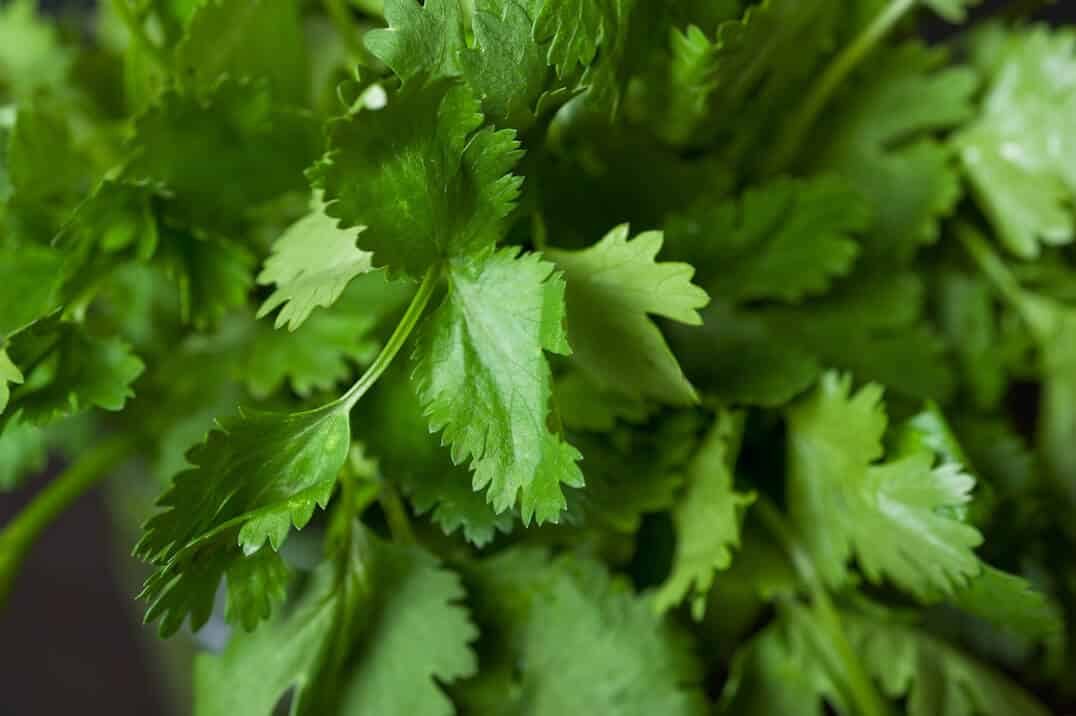
Why does cilantro taste bright and citrusy to some people and like soap to others? A large genetic study traced part of that split to a variant in a cluster of smell-receptor genes, though genes explain only part of the reaction. Cilantro is the fresh leaf and stem of Coriandrum sativum, the same plant whose dried fruit is sold as coriander seed. As the fruit ripens, the aldehydes behind the leaf’s smell disappear, and the spice tastes nothing like the herb.
At a glance
| Botanical name | Coriandrum sativum L. |
| Plant family | Apiaceae (carrot/parsley family) |
| Part used | Fresh leaves and stems; the dried fruit is the spice coriander |
| Other names | Coriander leaf, Chinese parsley; dhania in Hindi |
| Native range | Eastern Mediterranean to western Pakistan (Kew) |
| Key aroma compounds | Aldehydes, more than 80% of the leaf’s volatile oil1 |
| Forms sold | Fresh bunches; dried leaf |
Measured values
5 figures, sourced| Measure | Value | Scope | Source |
|---|---|---|---|
| Volatile oil | about 4 mg per g of fresh leaves | fresh cilantro leaves (PROSEA) | uses.plantnet-project.org |
| Aldehydes | more than 80 % of leaf volatile oil | fresh cilantro leaves (PROSEA) | uses.plantnet-project.org |
| (E)-2-Dodecenal | 15.6 % of leaf volatile oil | PROSEA composition table | uses.plantnet-project.org |
| (E)-2-Tetradecenal | 12.7 % of leaf volatile oil | PROSEA composition table | uses.plantnet-project.org |
| (E)-2-Decenal | 12.1 % of leaf volatile oil | PROSEA composition table | uses.plantnet-project.org |
Each figure is quoted as its source states it, with the samples or standard it applies to. Where sources differ, both are shown; nothing is averaged. All measured values
What cilantro is
Cilantro and coriander are one species. In the United States, “cilantro” usually means the leaf and “coriander” the seed; in much of the English-speaking world, both are coriander. The plant is an annual, an upright, branching herb that can reach 1.3 m, with a well-developed taproot. Its small flowers are white or pale pink, in umbels. It’s a cool-season crop that tends to bolt, or run to seed, in hot weather.
“Cilantro” came into English by 1907 from Spanish, a variant of culantro, which comes from Latin coriandrum. “Coriander” goes back through Old French and Latin to Greek koriannon. Culantro is now also the common name of a different plant; see culantro and culantro vs. cilantro.
Flavor and aroma
Descriptions of cilantro run anywhere from citrusy with a biting tang to soapy, and some people just plain dislike it. If you like it, it’s fresh, green and lemony, and it fades fast with heat.
The compounds
PROSEA puts the leaf’s volatile oil at about 4 mg per gram of fresh leaves, and says aldehydes make up more than 80% of it. The biggest components in its table are (E)-2-dodecenal (15.6%), (E)-2-tetradecenal (12.7%) and (E)-2-decenal (12.1%).1 Eriksson and colleagues also describe cilantro’s key aroma components as various aldehydes, in particular (E)-2-alkenals and n-aldehydes. They note that the (E)-2-alkenals, mostly (E)-2-decenal and (E)-2-dodecenal, are described as soapy, fatty, “like cilantro” or pungent.2 PROSEA calls these compounds bug-like in odor and places them in the roots, stems and leaves. A 2023 review says the same of the leaf oil: its odor is unpleasant because of aliphatic aldehydes.3
The seed is a different story. As the fruit ripens, PROSEA says, the aldehydes in the oil disappear and the fruit’s smell changes noticeably. Ripe coriander seed oil is dominated by linalool instead, so the spice tastes nothing like the leaf.13 For the seed side, see coriander and coriander vs. cilantro.
Why some people taste soap
In 2012, Eriksson and colleagues ran a genome-wide association study on 14,604 participants of European ancestry who reported whether cilantro tasted soapy. They replicated it in a separate group of 11,851 participants who said whether they liked cilantro. They found one variant, rs72921001, in a cluster of olfactory receptor genes on chromosome 11. One of those genes, OR6A2, codes for a receptor with high binding specificity for several of the aldehydes that give cilantro its characteristic smell.2
The effect is real but small. The same study estimated the heritability of soapy-taste detection tagged by common variants at about 0.087, lower than a twin study’s estimates of 0.38 for odor and 0.52 for flavor. So genes explain only part of the reaction, and the study doesn’t identify what explains the rest. Ancestry mattered too: African-Americans, Latinos, East Asians and South Asians in the study were all significantly less likely than Northern Europeans to report a soapy taste.2 The study doesn’t give a percentage of people who taste soap, and neither do we.
Origin and history
Kew gives the species’ native range as the eastern Mediterranean to western Pakistan.4 Britannica says the Mediterranean and Middle East.5 The archaeological record is mostly about the seed. PROSEA reports the oldest remains, dated to 6000 BC, from Israel, and coriander seed has turned up in Egyptian tombs.16 The plant’s history lives on the coriander page.
For the Americas, the Spanish conquistadors brought it to Mexico and Peru. We found no source for a more precise date.
How cilantro is used
The young leaves are widely used in Latin American, Indian and Chinese dishes. The leaves and whole young plants are a popular herb and vegetable, in chutneys and soups for example, and the aromatic taproots are eaten as a vegetable in China and Thailand.
- Mexico. Cilantro goes into salsas and meat dishes. It also gets folded into guacamole and scattered over tacos.
- India and the Arab world. It’s a standard finishing herb for Indian curries and dals, and Arabic cooking uses both leaves and seeds in pickles, curries and chutneys.
- Southeast Asia. Thai cooking uses the roots as well as the leaves.
Technique
Cilantro is one of the delicate herbs LSU AgCenter recommends adding in the last minute or two of cooking, because long cooking costs flavor and aroma.7 Most cooks add it raw, at the end. The stems have plenty of flavor, so chop them in with the leaves.
Dried cilantro has a reputation as a weak stand-in for fresh, though none of our sources measures how much aroma drying takes out. LSU’s general rule of thumb for herbs is 1 tablespoon of fresh to 1 teaspoon of dried.7 See dried vs. fresh cilantro and cooking with cilantro. Overdid it? See too much cilantro.
Buying and storage
Look for bright green, perky leaves with no yellowing or slime. The Wisconsin Master Gardener program says cut leaves keep in the refrigerator for about a week.6 For methods, see how to store cilantro, can you freeze cilantro and how to dry cilantro.
Safety
Cyclospora and fresh cilantro from Puebla
The FDA links recurring US outbreaks of cyclosporiasis in 2012, 2013, 2014 and 2015 to fresh cilantro from the state of Puebla, Mexico.8 Cyclosporiasis is caused by Cyclospora cayetanensis, a human intestinal parasite.8 Since July 27, 2015, the FDA has applied import controls. Under Import Alert 24-23, fresh cilantro from Puebla offered for entry between April 1 and August 31 of each year can be detained without physical examination, unless it comes from a firm on a “Green List” of companies that meet minimum agricultural and food-safety requirements set with Mexican authorities.89
Health claims
Cilantro often gets credit for controlling blood sugar, killing bacteria and supplying loads of vitamins. We make no claim that cilantro treats or prevents any condition. We couldn’t retrieve USDA nutrient data for this review, so there are no vitamin figures here.
Substitutes and comparisons
No other herb reproduces cilantro’s aldehyde-driven smell, so every swap changes the dish. See cilantro substitutes for ranked options, and these comparisons:
- Cilantro vs. parsley and coriander vs. parsley
- Chervil vs. cilantro
- Basil vs. cilantro
- Cilantro vs. oregano
- Culantro vs. cilantro
Footnotes
-
Coriandrum sativum, Plant Resources of South-East Asia (PROSEA). uses.plantnet-project.org · Reference work ↩ ↩2 ↩3 ↩4
-
Eriksson et al., “A genetic variant near olfactory receptor genes influences cilantro preference”, Flavour, 2012. link.springer.com · Peer-reviewed ↩ ↩2 ↩3
-
Al-Khayri et al., “Essential Oil from Coriandrum sativum: A Review on Its Phytochemistry and Biological Activity”, Molecules, 2023. mdpi.com · Peer-reviewed ↩ ↩2
-
Coriandrum sativum L., Plants of the World Online, Royal Botanic Gardens, Kew. powo.science.kew.org · Reference work ↩
-
“Coriander”, Encyclopaedia Britannica. britannica.com · Reference work ↩
-
Susan Mahr, “Cilantro”, Wisconsin Master Gardener Program, University of Wisconsin-Madison, 2017. mastergardener.extension.wisc.edu · Reference work ↩ ↩2
-
“Flavorful Herbs”, LSU AgCenter. lsuagcenter.com · Reference work ↩ ↩2
-
Import Alert 24-23, U.S. Food and Drug Administration. accessdata.fda.gov · Regulator ↩ ↩2 ↩3
-
“U.S. and Mexico Partnership Enhances Safety of Fresh Cilantro”, U.S. Food and Drug Administration. fda.gov · Regulator ↩
Also drawn on
- cilantro (n.), Online Etymology Dictionary. etymonline.com
- coriander (n.), Online Etymology Dictionary. etymonline.com